
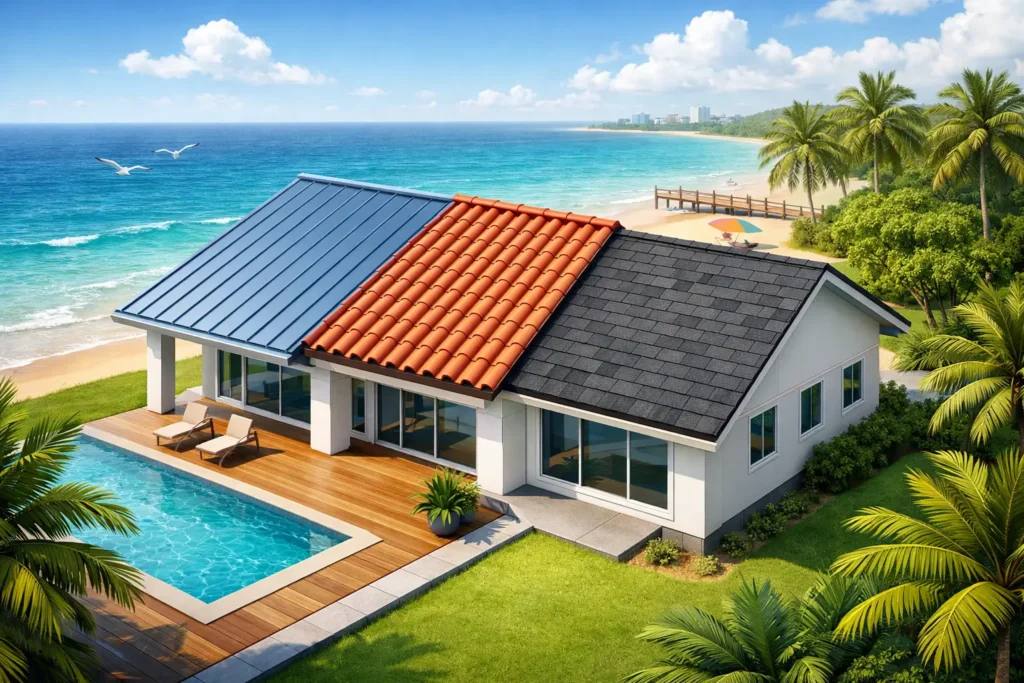
A coastal roof does not fail the same way an inland roof fails. Along Florida’s East Coast, salt travels farther than many property owners expect, settling on panels, flashing, fasteners, gutters, vents, and exposed cut edges. Add intense sun, wind-driven rain, hurricane conditions, and year-round humidity, and a material that performs well elsewhere may need a much more careful installation here.
The best roof for salt air exposure is usually not a single material for every property. It is a complete system chosen for your distance from the coast, roof design, wind requirements, budget, and willingness to maintain it. For many coastal Florida homes, properly specified aluminum metal roofing or tile roofing offers the strongest long-term answer. For low-slope commercial properties, a high-quality membrane roof with compatible accessories and drainage design may be the better fit.
Why salt air changes the roofing decision
Salt is corrosive, but it does not need to be splashed directly onto your roof to cause trouble. Ocean air carries salt particles inland. Those particles cling to damp surfaces, especially around laps, penetrations, valleys, fasteners, and areas where water sits after a storm.
That is why coastal roof selection is about more than the roof covering. A beautiful metal panel can develop premature corrosion if the fasteners, flashings, trim, gutters, or underlayment details are not designed for the same environment. A tile roof can last for decades, but poor attachment methods or neglected flashing can still create a costly leak path.
Florida’s building code and local wind requirements matter just as much. The roof needs to resist uplift in severe weather while managing water and salt exposure over time. No shortcuts. No mismatched components.
Best roof for salt air exposure: aluminum metal
For homes close to the coast, aluminum standing seam metal roofing is often one of the best-performing choices. Aluminum does not rust the way steel does, which gives it a real advantage where salt spray and airborne salt are routine. It is lightweight, highly wind-resistant when installed correctly, and available in finishes that reflect heat and support curb appeal.
Standing seam systems also limit exposed fasteners. The panel clips and concealed fastening details reduce the number of locations where fasteners can corrode or back out. That does not eliminate maintenance, but it removes a common weak point found on exposed-fastener metal systems.
Aluminum is not automatically maintenance-free. Coastal owners should still rinse off salt buildup when practical, inspect sealants and flashings, and address scratches or finish damage promptly. It also costs more upfront than shingles and many steel options. For homeowners planning to stay in the property, that higher initial investment can make sense because the material is built for the environment rather than simply trying to survive it.
What about galvanized or Galvalume steel?
Steel metal roofing can be a strong, attractive option in many parts of Florida, particularly farther inland. But the closer a property is to the ocean, the more carefully it must be specified. Galvanized steel and Galvalume-coated steel depend on protective coatings, paint systems, proper cut-edge treatment, and compatible hardware to hold up against corrosion.
A steel roof may still be appropriate for your property, but it should not be selected solely because metal roofing is durable in general. Ask about the panel material, coating type, fastener grade, flashing material, manufacturer guidance for coastal use, and the warranty terms that apply to salt-air conditions. Those details separate a durable system from an expensive disappointment.
Tile roofing: durable, coastal-ready, and heavy
Concrete and clay tile are another excellent choice for many Florida coastal homes. Tile itself does not rust, stands up well to sunlight, and offers the substantial look many homeowners want in coastal and Mediterranean-style neighborhoods. Clay tile can provide exceptional longevity, while concrete tile often delivers a more accessible price point and broad range of profiles and colors.
The trade-off is weight and complexity. Tile roofing needs a structure capable of supporting it, and every detail beneath the tile matters. The underlayment, battens, attachment method, flashing, valleys, and penetrations must be designed for Florida wind and water conditions. The tile may outlast the underlayment below it, so future maintenance planning matters.
Salt air can still affect the metal components used with tile. Coastal-grade fasteners, flashings, and accessories are not optional details. They are part of the roof’s service life. A properly installed tile system can be an outstanding long-term investment, but it demands experienced installation and careful material coordination.
Architectural shingles: practical, but not the longest coastal play
Architectural asphalt shingles remain a practical roofing choice for many Florida homeowners. They typically cost less than metal or tile, offer a wide range of colors, and can provide dependable protection when installed to the correct wind rating with quality underlayment and ventilation.
Shingles are not generally damaged by salt in the same way bare steel components are. However, the roof still relies on metal flashings, nails, vents, drip edges, and other accessories that must withstand the coastal environment. Florida heat, ultraviolet exposure, wind, and heavy rain can also shorten shingle life compared with milder regions.
For a homeowner balancing budget, insurance requirements, and a near-term roof replacement, architectural shingles can be the right decision. Just be realistic about the expected service life and choose a system with strong wind performance. If your home sits very close to the ocean and you want the longest possible lifespan, aluminum metal or tile often deserves a closer look.
Flat and low-slope roofs need a different answer
Commercial buildings, condominiums, additions, and modern homes often have low-slope or flat roof areas. Here, the best answer is usually a professionally designed membrane system rather than shingles, tile, or residential metal panels.
TPO, PVC, modified bitumen, and silicone coating systems can each serve a purpose, depending on the existing roof, drainage, foot traffic, budget, and condition of the substrate. PVC is often considered a strong contender in coastal commercial applications because of its chemical resistance and heat-welded seams. TPO can also perform well when it is correctly installed and maintained. A roof coating may extend service life in the right situation, but it is not a substitute for replacement when the underlying system is saturated, deteriorated, or poorly draining.
Salt exposure makes drainage and edge detailing especially important. Standing water accelerates wear, and poorly protected metal edge components can become a failure point. A low-slope roof should be evaluated as a whole assembly, not priced by membrane square footage alone.
The components that make or break a coastal roof
A coastal roof is only as durable as its weakest component. When comparing estimates, make sure the conversation includes more than the visible material. Four areas deserve special attention:
- Fasteners and clips: Stainless steel or manufacturer-approved corrosion-resistant hardware helps prevent early rusting and loosening.
- Flashings and trim: Valleys, wall flashings, chimney details, drip edge, and pipe boots must be compatible with the primary roof material and coastal conditions.
- Underlayment and waterproofing: High-quality underlayment provides critical secondary protection when wind-driven rain gets beneath the outer roof covering.
- Ventilation and drainage: Proper airflow reduces heat and moisture stress, while clear drainage prevents water from lingering around vulnerable details.
Ask whether the quote includes replacement of deteriorated decking, new flashings, appropriate fasteners, and permit compliance. A lower estimate can become expensive if it leaves out the parts that actually protect the structure.
How to choose the right system for your property
Start with location. A home a few blocks from the beach faces a different salt load than a property several miles inland, even within the same city. Exposure also changes with elevation, nearby open water, prevailing wind, and whether trees or neighboring buildings provide protection.
Next, consider how long you expect to own the property. If you are preparing to sell soon, a high-quality architectural shingle roof may offer the best balance of protection and investment. If this is a long-term home near the water, aluminum standing seam or tile may justify the additional cost through durability, appearance, and reduced concern about corrosion.
For commercial owners and property managers, prioritize lifecycle cost over initial price. Downtime from leaks, tenant disruption, interior damage, and repeated patching can exceed the savings from choosing a lower-grade system. A thorough inspection should identify drainage issues, existing moisture, deck condition, penetrations, and the condition of all perimeter details before a replacement plan is finalized.
A coastal roof should give you confidence when the forecast turns ugly, not another maintenance problem waiting to happen. Bear Roofing helps Florida property owners match the roof system, installation details, and warranty coverage to the conditions their building actually faces. The right decision starts with an honest assessment of the roof you have and the exposure it must withstand.