
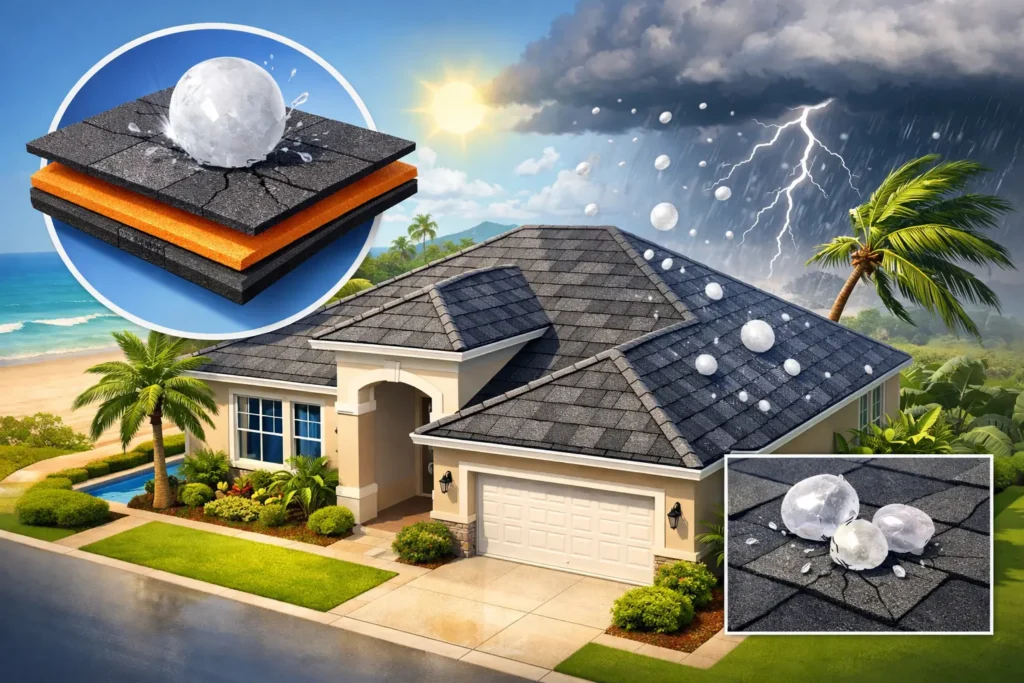
A Florida roof does not get a quiet season. Summer heat bakes the shingles, afternoon storms hammer them with rain, and hurricane season brings wind-driven debris that can turn a minor weak point into a major leak. That is why impact resistant shingles Florida homeowners choose deserve more than a quick look at color and price. The right system must be rated correctly, installed to code, and matched to the conditions around your property.
For many homes along Florida’s East Coast, impact-resistant shingles are a practical upgrade during roof replacement. They can reduce damage from hail and flying debris, offer a traditional architectural-shingle appearance, and may help support an insurance discount. They are not indestructible, though, and they are not a substitute for proper fastening, ventilation, flashing, or storm preparation. The details matter.
What Makes a Shingle Impact Resistant?
Impact resistance refers to a shingle’s ability to withstand a hard strike without cracking, splitting, or exposing the roof beneath it. Most homeowners will see this expressed as a UL 2218 rating, a test that evaluates how roofing materials perform when struck by steel balls intended to simulate hail impact.
Class 4 is the highest common impact-resistance rating. In broad terms, a Class 4 shingle has passed the most demanding level of this test. These shingles are often built with modified asphalt, reinforced mats, or flexible polymer components that better absorb an impact than conventional asphalt shingles.
That rating is valuable, but it should be understood for what it is. UL 2218 measures impact performance under a controlled test. It does not mean a roof cannot be damaged by a falling branch, prolonged wind uplift, poor installation, or debris driven at high speed during a hurricane. A Class 4 shingle is a stronger layer of protection, not a guarantee against every Florida storm.
Why Impact Resistant Shingles Matter in Florida
Florida roofs face a combination of weather forces that few roofing systems endure elsewhere. High UV exposure can age asphalt. Heavy rain finds small installation errors quickly. Salt air near the coast can accelerate wear on metal components. Then there are tropical storms and hurricanes, where wind pressure and airborne debris test the entire roofing assembly.
Impact-resistant shingles can be especially worthwhile for homeowners with mature trees, open lots, or neighborhoods that routinely see severe summer storms. They can also make sense for owners who want the familiar look of dimensional shingles but want more resilience than a standard product may provide.
The decision still depends on the home. A property directly on the coast may need a broader conversation about coastal wind requirements, roof deck condition, underlayment, fastener selection, and whether metal or tile is a better long-term fit. A home in Palm Bay or a nearby inland community may benefit greatly from a Class 4 shingle system, provided the product is approved for the home’s wind zone and installed as a complete system.
The Rating Is Only One Part of Roof Protection
A strong shingle installed on a weak roof deck will not perform as intended. Neither will a premium shingle paired with inadequate flashing or improper nail placement. Florida roofing is a system, and every layer has a job.
The roof deck provides the foundation. If decking is deteriorated, loose, or damaged by moisture, it should be addressed before new materials go on. Underlayment creates a critical secondary water barrier. In many Florida applications, a self-adhered underlayment offers meaningful protection if wind or debris damages the outer shingle layer.
Fastening is equally important. Shingles must be nailed in the manufacturer’s designated nailing zone using the correct fastener type and pattern. High-wind installation requirements are not optional upgrades when the product instructions or local code call for them. Poorly placed nails can reduce wind performance, affect warranty coverage, and create avoidable vulnerability during a storm.
Flashing at walls, valleys, chimneys, skylights, and penetrations deserves the same attention. Most roof leaks do not begin in the middle of a shingle field. They begin where materials meet, water changes direction, or an old detail was covered instead of corrected.
Insurance Savings: Ask Before You Buy
One of the most common questions about impact-resistant shingles is whether they lower insurance premiums. The answer is sometimes, not always.
Some Florida insurers offer discounts for qualifying Class 4 roofing materials. Others may have specific documentation requirements, product lists, inspection standards, or policy restrictions. The savings can vary by carrier, property location, roof age, and the rest of the home’s wind-mitigation features.
Before choosing a shingle based on a projected discount, contact your insurance agent or carrier. Ask what documentation is required and whether the selected product qualifies under your policy. Keep copies of the product information, permit records, final invoice, and any inspections completed after installation.
It is also wise to separate an impact rating from a wind-mitigation credit. They are related to storm protection, but they are not the same thing. Credits for features such as roof-to-wall connections, opening protection, and roof deck attachment may be evaluated separately. A contractor familiar with Florida insurance claims and building requirements can help you understand what the roofing work can document and what may require additional upgrades.
What Do Impact-Resistant Shingles Cost?
Impact-resistant architectural shingles usually cost more than standard architectural shingles. The material itself is often more expensive, and a proper Florida installation may include upgraded underlayment, enhanced fastening, deck repairs, and code-required details that affect the total project price.
The better question is not simply, “What is the price per square?” It is, “What protection is included in the installed roofing system?” An estimate should clearly identify the shingle product and rating, underlayment type, flashing work, ventilation approach, permit responsibilities, deck-replacement pricing, cleanup, and warranty coverage.
A lower quote may leave out items that become expensive change orders later. It may also rely on materials or installation methods that do not provide the protection you expected. No surprises. No disappearing act. A credible contractor should explain the scope before work begins and put the important details in writing.
Choosing the Right Shingle for Your Home
Appearance still matters. Architectural shingles come in colors and profiles that can complement coastal, traditional, ranch, and contemporary Florida homes. Yet color should follow performance decisions, not lead them.
Start with the shingle’s approved wind rating for your location and roof design. Then look at the manufacturer’s Class 4 documentation, warranty terms, algae-resistance options, and color availability. Darker shingles can create a bold look, but they may absorb more heat. Lighter colors can better suit a home’s exterior palette and may be worth considering where attic heat is a concern.
Your roof slope matters as well. Shingles are designed for sloped roofs and require specific installation approaches at lower slopes. Flat or low-slope commercial areas, porches, and additions may need a different membrane roofing system instead of shingles. For mixed rooflines, the best solution may combine systems rather than force one material across every surface.
A professional inspection should also identify tree limbs overhanging the roof, existing soft spots, inadequate intake or exhaust ventilation, and aging gutters. These conditions can shorten the life of any shingle, including impact-resistant products.
Installation Questions Worth Asking
A roofing proposal should make it easy to compare more than brand names. Ask whether the contractor will obtain permits, follow local Florida code, inspect the decking after tear-off, and explain how unexpected wood replacement is handled. Ask what underlayment is included, how valleys and penetrations will be flashed, and whether the work follows the shingle manufacturer’s high-wind requirements.
Also ask who manages the project from start to finish. A roof replacement is disruptive, but it should not leave you coordinating crews, material deliveries, permits, and cleanup on your own. Bear Roofing approaches the work as a managed project, with clear communication from inspection through final cleanup and workmanship protection that stands behind the installation.
Finally, confirm the warranty in plain language. Manufacturer warranties generally address material defects under stated conditions. A workmanship warranty addresses installation. Both have value, but they cover different risks. Know what is covered, for how long, and what maintenance or documentation may be required.
When an Impact-Resistant Shingle Is Not the Best Fit
Class 4 shingles are an excellent choice for many Florida homes, but they are not automatically the right answer for every property. A homeowner prioritizing the longest possible service life may prefer metal. A home with a heavy, steep roof structure and a particular architectural style may be better suited to tile. A low-slope roof needs a system designed for low-slope drainage, not shingles adapted beyond their intended use.
The most dependable recommendation begins with the roof you have, the exposure it faces, and the protection you want to carry forward. Choose materials that meet Florida’s demands, insist on an installation built layer by layer, and make the decision before the next storm puts pressure on it.