
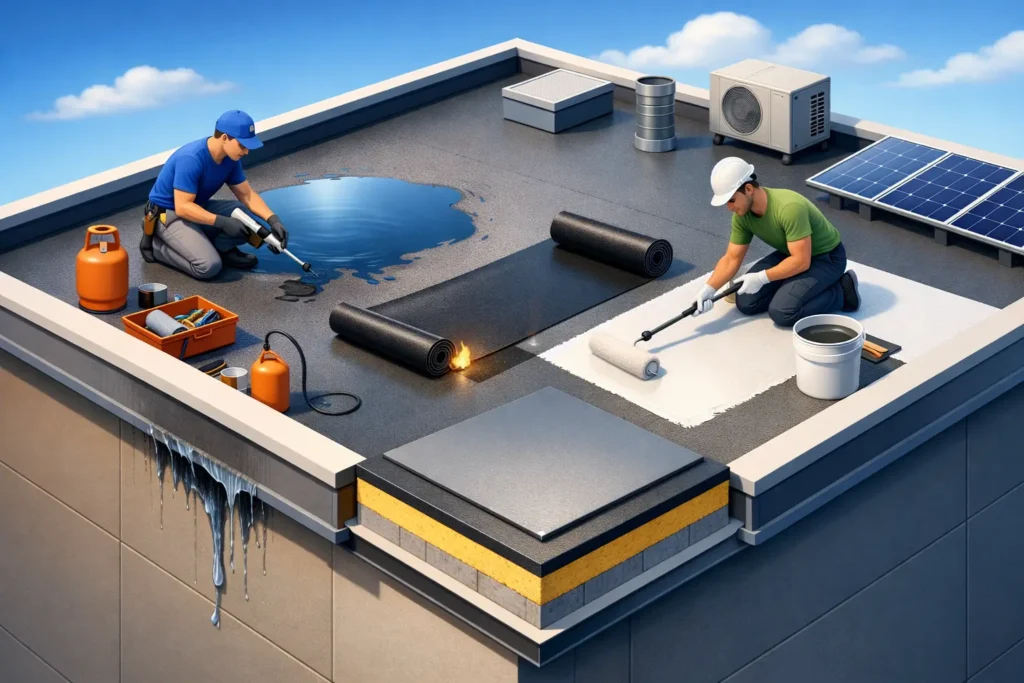
A flat roof usually does not give you much warning. One hard rain, one seam that opens up, one clogged drain holding water too long, and suddenly you are dealing with stained ceiling tiles, wet insulation, or an active drip over a workspace. When property owners start comparing flat roof leak repair options, the real question is not just how to stop the water today. It is how to fix the problem in a way that makes sense for the roof’s age, condition, and exposure to Florida weather.
On the East Coast of Florida, that decision matters even more. Heat, UV exposure, wind-driven rain, salt air, and hurricane season all put low-slope roofing systems under constant stress. A quick patch may hold for a while, but if the leak is a symptom of broader membrane failure or trapped moisture, the cheapest repair can become the most expensive path.
How to evaluate flat roof leak repair options
The best repair starts with diagnosis, not guesswork. Flat roofs leak in ways that are not always obvious from the interior. Water can enter at a seam, flashing edge, drain, penetration, or puncture, then travel across the roof assembly before it shows up inside. That is why the visible leak point is often not the true source.
A proper inspection should look at membrane condition, seam integrity, edge metal, coping, drains, scuppers, flashing around HVAC units and vents, and any signs of ponding water. It should also consider the roof’s system type. Modified bitumen, TPO, PVC, built-up roofing, and coated flat roofs each have different repair methods, and using the wrong one can create bigger problems later.
Age matters too. A relatively new roof with isolated storm damage may be a strong candidate for a targeted repair. An older roof with widespread cracking, open laps, or saturated insulation may need more than a patch. No surprises. No disappearing act. Just a clear explanation of what failed and what will actually hold up.
The most common flat roof leak repair options
Localized patch repairs
If the leak is limited to a small puncture, split, or isolated seam issue, a localized patch may be the right move. This is often the most affordable repair option in the short term, especially when the surrounding roof is still in serviceable condition.
The patch method depends on the roof material. On single-ply systems such as TPO or PVC, a compatible welded patch may be used. On modified bitumen, the repair may involve reinforcing fabric and asphalt-based or cold-process materials designed for that system. The key is compatibility. A patch made with the wrong product may not bond correctly and can fail under heat and rain exposure.
Localized repairs work best when the damage is truly isolated. They are less effective when the roof has multiple weak points or when the membrane has become brittle across larger sections.
Seam and flashing repairs
Many flat roof leaks start at transitions rather than in the field membrane. Flashing around penetrations, parapet walls, curbs, skylights, and equipment supports sees constant movement and weather exposure. Seams also expand and contract over time, particularly under intense sun.
In these cases, repairing or re-securing flashing and seams can solve the leak without replacing broad areas of roofing. That might involve heat welding, resealing, reinforcing, or replacing failed detail materials. This option is often cost-effective, but it depends on the condition of the adjacent roof areas. If detail failures are widespread, repeated spot work can turn into a cycle of temporary fixes.
Drainage corrections
Sometimes the membrane is not the main issue. Water that sits too long on a flat roof will eventually find a way in. Clogged drains, poor slope, low spots, or blocked scuppers can turn a minor vulnerability into a recurring leak.
Correcting drainage may involve cleaning and restoring drains, adjusting components, adding tapered insulation in problem areas, or addressing sections where water consistently ponds. This is not always the first repair owners think of, but on Florida commercial and residential flat roofs, it can be one of the most important. A roof that sheds water properly tends to last longer and leak less often.
Roof coatings as a restoration option
When a flat roof is aging but still structurally sound, a roof coating can sometimes extend its life and improve waterproofing. Coatings are not a cure-all, and they should never be applied over a failing roof just to make it look better for a season. But in the right situation, they can be a smart middle-ground option between repair and replacement.
A coating system usually starts with repairs to seams, penetrations, and damaged areas. After the roof is prepared, a compatible coating is installed to create a continuous protective surface. This can help with waterproofing, UV resistance, and even energy performance, depending on the product used.
The trade-off is that coatings depend heavily on prep work and substrate condition. If moisture is trapped below the surface or the existing membrane is too deteriorated, a coating may not last the way you expect.
When repair is enough and when replacement is smarter
This is where many owners get stuck. They do not want to replace a roof if a repair will do the job, but they also do not want to keep spending money on service calls every few months.
A good rule of thumb is to look at pattern, not just price. If the roof has one known issue and the rest of the system is performing well, repair is usually the practical choice. If leaks keep showing up in new areas, if water has entered insulation, or if the membrane is near the end of its service life, replacement may be the more responsible investment.
For commercial properties, downtime matters. Repeated leaks can damage inventory, interrupt operations, and create liability concerns. For homeowners, chronic leaks can affect ceilings, drywall, insulation, and indoor air quality. What looks like a roofing expense can quickly become an interior restoration bill.
That is why the best recommendation is rarely the one with the lowest upfront number. It is the one that solves the problem at the right stage of the roof’s life cycle.
Florida factors that change the repair decision
Not every roofing market is the same, and Florida changes the math. Wind uplift requirements, intense UV exposure, heavy seasonal rain, and storm-related damage all affect how flat roof leak repair options should be evaluated.
A repair that might be acceptable in a milder climate may not hold up as well here if edge securement is weak or if materials are not suited for prolonged heat and moisture. Salt air near the coast can also accelerate wear on metal components and fasteners. Add in insurance considerations after storm events, and documentation becomes just as important as workmanship.
This is where working with a contractor who understands local code requirements and storm behavior matters. Bear Roofing serves Florida property owners who need that level of clarity, especially when the roof issue may involve both repair strategy and insurance documentation.
What to ask before approving a repair
Before moving forward, ask what caused the leak, whether the proposed repair matches the existing roofing system, and how much of the surrounding roof was inspected. You should also ask whether there are signs of trapped moisture, whether drainage is part of the problem, and how long the repair is expected to last under current roof conditions.
A trustworthy contractor should be able to explain the trade-offs plainly. If a repair is temporary, that should be stated clearly. If a coating could extend the roof life but only after specific prep work, you should hear that too. Honest roofing guidance is not about selling the biggest project. It is about protecting the building and helping the owner make a sound decision.
Choosing the repair path with confidence
Flat roofs can often be repaired successfully, but only when the repair matches the real problem. A patch has its place. So do seam repairs, drainage corrections, restoration coatings, and full replacement when the system is beyond practical repair. The right answer depends on the roof’s condition, the building’s needs, and how much risk you are willing to carry into the next storm season.
If your flat roof has started leaking, treat that leak as a signal, not a nuisance. The sooner the issue is inspected and correctly diagnosed, the more options you usually have – and the better your chance of fixing it once instead of paying for the same problem twice.