
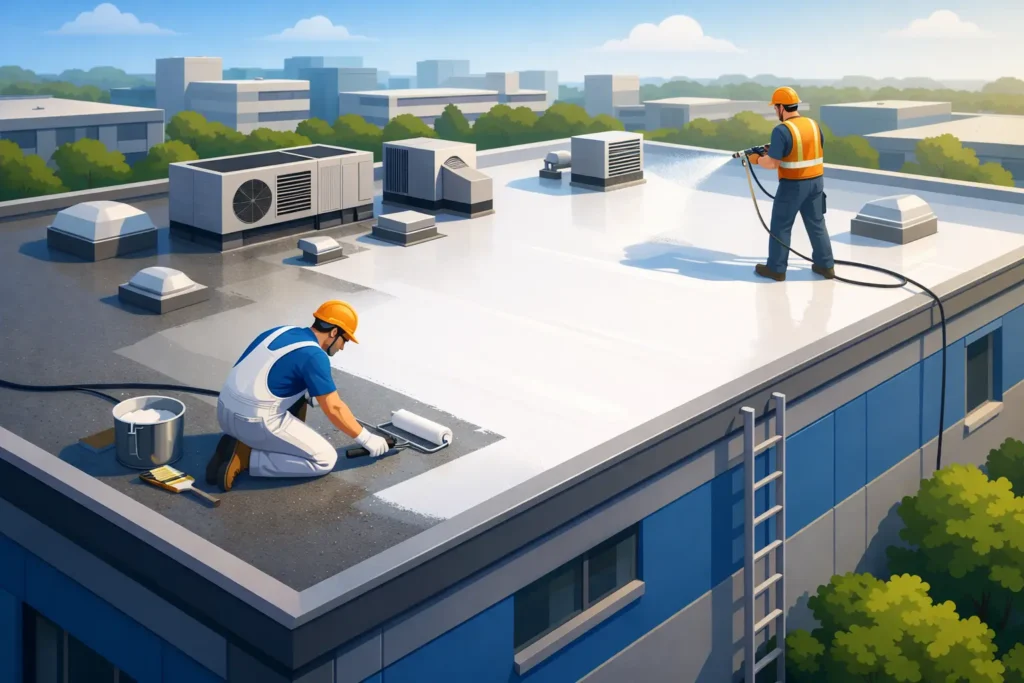
A commercial roof in Florida does not get a quiet life. Sun beats on it for months, afternoon storms hit hard, and wind-driven rain finds every weak seam, flashing edge, and ponding spot. That is why roof coating for commercial buildings gets serious attention from property owners and facility managers who want longer roof life without the cost and disruption of a full tear-off.
For the right building, a coating can buy valuable years, improve waterproofing, and reduce heat gain. For the wrong roof, it can become an expensive patch that delays a bigger problem. The difference comes down to condition, system type, preparation, and how honestly the roof is evaluated before any product is applied.
What roof coating for commercial buildings actually does
A commercial roof coating is a fluid-applied membrane installed over an existing roof surface. Once cured, it creates a continuous protective layer that helps resist UV damage, weathering, and water intrusion. On many low-slope and flat roofs, that extra layer can restore performance without removing the entire roofing system.
That sounds simple, but coatings are not one-size-fits-all. Acrylic, silicone, polyurethane, and other specialty systems each behave differently. Some are better for intense sun and energy savings. Others handle ponding water better. Some work well over modified bitumen, metal, or single-ply systems, while others require primers or reinforcement to bond correctly.
In Florida, where heat, humidity, salt air, and heavy rain all work against a roof at once, the coating choice matters as much as the application itself.
When a coating is a smart move
The best candidate for a roof coating is a commercial roof that is aging but still structurally sound. If the insulation is dry, the deck is intact, and the existing membrane has not reached total failure, a coating can be a cost-conscious way to extend service life.
This is often attractive for retail centers, warehouses, offices, churches, multifamily properties, and light industrial buildings trying to avoid a major capital expense this year. A quality coating system can also reduce business disruption because installation is usually less invasive than a full replacement.
A coating may make sense if your roof has surface wear, minor leaks tied to isolated details, sun degradation, or rising cooling costs. It can also be a practical option when a property owner wants to improve reflectivity and buy time to plan a future replacement on better financial terms.
That said, buying time only helps when the roof beneath the coating is worth saving.
When a coating is not enough
Some roofs need repair. Some need replacement. A coating should never be used to hide saturated insulation, widespread membrane failure, severe storm damage, or structural issues.
If water has been trapped below the surface for a long time, a coating on top will not solve the root problem. The same goes for roofs with major separation at seams, extensive punctures, deteriorated decking, or repeated leak patterns from neglected maintenance. In those cases, coating over the trouble can trap moisture, shorten performance, and create a false sense of security.
This is where an honest inspection matters. A dependable contractor should tell you when a coating is a strong fit and when it is not. No surprises. No disappearing act. Just a clear assessment of what the roof can support.
The most common coating types for commercial roofs
Not every commercial coating performs the same way in Florida conditions.
Acrylic coatings are popular because they are reflective, cost-effective, and strong against UV exposure. They are often a good fit when energy efficiency is a priority. The trade-off is that acrylics generally do not handle long-term ponding water as well as silicone.
Silicone coatings are frequently chosen for roofs where standing water is a concern. They resist moisture very well and hold up under harsh sun. The trade-off is that they can attract dirt over time, and future recoating or repairs may require more specific preparation.
Polyurethane coatings are known for durability and impact resistance. They can be useful in areas with foot traffic or where the roof needs a tougher surface. They are often more expensive, so they are usually selected for specific performance reasons rather than budget alone.
The right system depends on roof type, drainage, building use, budget, and how long you want the solution to last.
Preparation is where good coating jobs are won or lost
Property owners often focus on the product brand, but prep work is what separates a coating system that lasts from one that starts failing early.
The roof has to be cleaned thoroughly. Existing damage has to be repaired. Wet materials have to be removed where needed. Seams, penetrations, drains, flashing transitions, and fasteners all need detailed attention before the field coating goes down. Some roofs also need primers or reinforcement fabric in high-stress areas.
If a contractor rushes through preparation, the coating can lose adhesion, blister, split at movement points, or allow leaks to continue around problem details. On a commercial roof, most failures do not start in the middle of the field. They start at edges, penetrations, drains, and transitions.
That is why process matters. A coating is not just paint on a roof. It is a restoration system, and it only performs like one when the prep and detailing are done right.
Cost, value, and the real trade-off
One reason commercial owners consider coatings is cost. In many cases, a coating system is less expensive than a full replacement because it reduces tear-off labor, disposal, and business interruption. It can also delay a larger capital project while still improving protection.
But lower upfront cost should not be confused with automatic savings. If the underlying roof is a poor candidate, the money spent on coating may simply postpone the inevitable. On the other hand, if the roof is restorable, a coating can deliver strong value through extended lifespan, better reflectivity, and fewer leak-related repairs.
The real question is not whether coating is cheaper today. It is whether coating is the right investment over the next five to ten years based on the roof’s actual condition.
Florida factors commercial owners should not ignore
Roof coating for commercial buildings in Florida comes with regional realities. Salt air along the coast accelerates wear on exposed components. Intense UV breaks down roofing materials faster. Sudden downpours test drainage systems quickly. Hurricane season adds wind uplift concerns that affect both the underlying roof and any restoration strategy.
That means a commercial coating project should be planned with local code requirements, wind exposure, drainage patterns, and storm-readiness in mind. A contractor familiar with East Coast Florida conditions will evaluate more than surface appearance. They will look at how the roof has performed under real regional stress.
For owners in places like Palm Bay and surrounding coastal communities, local experience is not a bonus. It is part of risk management.
What to expect from the process
A professional coating project usually starts with inspection, moisture review, and a frank discussion about goals. Some owners want to stop recurring leaks. Others want energy savings, a longer service window, or a bridge before replacement.
From there, the scope should spell out repairs, surface prep, coating type, thickness, warranty terms, and project timing. Commercial owners should also ask how weather delays are handled, how tenant or operational disruption will be minimized, and what maintenance is recommended after installation.
This is also the point where transparency matters most. A trustworthy contractor will explain what the coating can do, what it cannot do, and what conditions could shorten its lifespan.
For many Florida businesses, that direct approach is what makes the process manageable. Companies like Bear Roofing build trust by handling projects from inspection through cleanup and keeping communication clear from start to finish.
Questions worth asking before you approve a coating
Before moving forward, ask whether the roof has trapped moisture, whether repairs are included before coating, and which product is best for your drainage conditions. Ask about warranty coverage, expected lifespan, and whether the proposed system is compatible with your current roof.
Also ask a practical question that gets overlooked – if the coating is meant to extend roof life, how many years are realistically expected, and what maintenance will protect that investment? A good answer should be specific, not sales talk.
A commercial roof does not need a guess. It needs a plan that fits the building, the budget, and the weather it has to face.
If your roof is still a solid candidate for restoration, a coating can be a smart way to protect the building, control costs, and avoid unnecessary replacement. If it is past that point, the right contractor should tell you that plainly. Either way, the best next step is the same: get the roof evaluated before the next storm season makes the decision for you.