
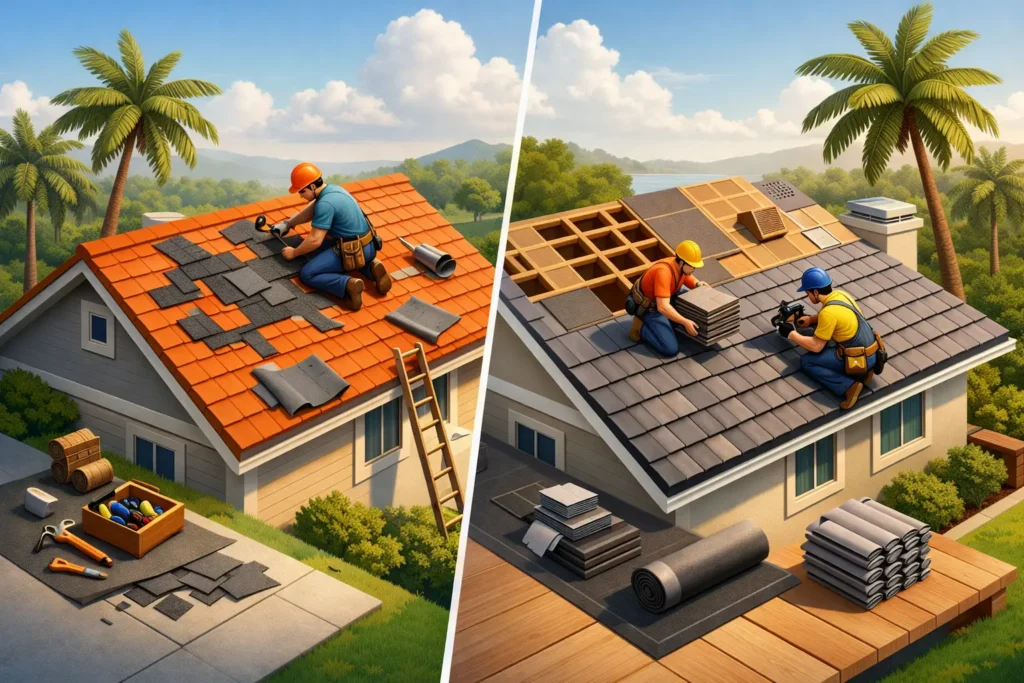
A roof leak rarely shows up at a convenient time. In Florida, it often appears after a hard storm, during a week of heavy rain, or right when you were hoping to avoid a major expense. That is why understanding roof repair vs replacement cost matters so much. The cheaper option upfront is not always the lower-cost decision over the next few years.
For homeowners and property managers on the East Coast of Florida, the real question is not just, “How much will this cost today?” It is, “What solves the problem without setting me up for another emergency six months from now?” That answer depends on the age of the roof, the extent of the damage, the roofing material, and how Florida weather has already worn the system down.
Roof repair vs replacement cost: the real difference
A repair is usually the lower immediate expense. If the issue is limited to a small section of missing shingles, a flashing failure, a minor leak around a vent, or isolated storm damage, repair may be the right move. In many cases, a targeted repair can restore waterproofing and buy meaningful time.
A replacement costs more because it addresses the full roofing system, not just the visible trouble spot. That includes underlayment, ventilation details, flashing transitions, fasteners, and in some cases damaged decking. You are paying for a long-term reset instead of a short-term fix.
The gap between the two can feel significant. A straightforward repair may cost a fraction of a full roof replacement. But if a roof is near the end of its service life, repeated repairs can turn into a pattern of spending that never fully solves the underlying problem.
What roof repairs usually cost in Florida
Roof repair pricing varies widely because the term “repair” covers a lot of ground. Replacing a few wind-damaged shingles is not the same as correcting a hidden leak that has spread under tile, saturated underlayment, or damaged decking near a valley.
In Florida, smaller residential repairs often fall into the hundreds or low thousands, depending on access, material type, and whether moisture has traveled beyond the visible point of failure. Tile repairs tend to cost more than shingle repairs because locating matching tiles, removing surrounding pieces without breakage, and preserving the integrity of the system takes more labor. Metal roof repairs can also be specialized, especially when seams, fasteners, or corrosion are involved.
Commercial and low-slope repairs are different again. A puncture in a membrane, separated seam, drainage problem, or flashing issue around rooftop units can require a highly specific fix. The price can still be reasonable if caught early, but costs rise quickly once water intrusion spreads into insulation or interior finishes.
What roof replacement usually costs
A full replacement is a bigger investment because it is a full-system project. Pricing depends on roof size, pitch, complexity, material choice, tear-off requirements, and code-related upgrades. In Florida, replacement costs can also reflect wind mitigation requirements, underlayment standards, permit needs, and the labor involved in meeting local code.
As a general rule, asphalt shingle roofs are often the most budget-friendly replacement option. Tile and metal typically cost more upfront but may offer longer service life, stronger wind performance, and better long-term value depending on the property and installation quality. Flat and low-slope systems vary based on membrane type, insulation needs, drainage improvements, and penetrations.
This is where transparency matters. A low quote is not always a lower-cost job if it skips critical details that protect the roof in Florida conditions. Coastal exposure, heat, wind uplift, driving rain, and salt air are hard on roofing systems. No surprises. No disappearing act. You want to know what is included, what is being replaced, and how the system is being built to last.
When repair is the smarter financial move
Repair usually makes the most sense when the damage is isolated and the rest of the roof is still in good condition. If your roof is relatively young, has been maintained properly, and has no pattern of recurring leaks, a well-executed repair can be the practical answer.
This is especially true after a storm when the issue is limited to one section. A branch impact, lifted flashing, or a handful of missing shingles does not automatically mean the entire roof has failed. In those cases, replacing the full roof may be unnecessary.
Repair can also be the right move when you need to stabilize the property quickly while planning for a future replacement. That approach can make sense for homeowners managing budgets or commercial owners scheduling work around tenant needs. The key is honesty about whether the repair is a real solution or just a temporary patch.
Signs a repair is likely enough
A repair is often worth considering if the roof is under 10 to 15 years old, the leak is limited to one area, the materials are still available, and there is no widespread sagging, soft decking, or repeated water intrusion. If the roofing system still has useful life left, a targeted repair can protect that value.
When replacement saves more money over time
Replacement starts to make more sense when repairs become repetitive, the roof is aging out, or the damage is more widespread than it first appears. A leak may begin as a ceiling stain, but the real problem may involve underlayment failure, multiple vulnerable penetrations, or storm wear across several slopes.
If you are paying for repairs every year, the math changes. At some point, putting more money into an old roof stops being responsible and starts being wasteful. That is particularly true in Florida, where one storm season can push an already weakened roof past the point of practical repair.
Replacement may also be the better financial decision if insurance, resale value, energy performance, or insurability are part of the equation. A new roof can improve buyer confidence, help with underwriting concerns, and reduce the risk of another emergency expense.
Signs replacement is the better call
If your roof is near the end of its expected lifespan, has widespread granule loss, cracked or missing materials in multiple areas, recurring leaks, sagging sections, or storm damage across the system, replacement is often the safer and more cost-effective route.
What drives the price either way
The biggest cost factors are material type, labor intensity, roof complexity, and hidden damage. A simple shingle roof with easy access is different from a steep, cut-up roof with valleys, skylights, chimneys, and multiple transitions. Every penetration and change in slope adds labor and flashing detail.
Water damage below the surface also changes the price. What looks like a small leak may involve rotten decking, compromised underlayment, mold concerns, or interior damage. That does not mean contractors are inflating the job. It means roofs fail in layers, and the visible symptom is not always the full story.
Florida code requirements matter too. Re-nailing decks, upgraded underlayment, improved ventilation, and edge metal details may be required depending on the scope of the project and local regulations. Those items add cost, but they also add protection where it counts.
The insurance factor
For many Florida property owners, the repair-versus-replacement conversation overlaps with an insurance claim. Storm damage from wind or hail may qualify for coverage, but every claim is different. Documentation, timing, and a clear inspection matter.
This is where expert guidance can make the process less stressful. A contractor who understands Florida storm damage and insurance expectations can help identify whether the issue is isolated or system-wide. That does not guarantee coverage, but it does help you make decisions based on facts instead of guesswork.
How to decide without overspending
Start with a thorough inspection, not a sales pitch. You need to know the roof’s age, the condition of the underlayment or membrane, whether the damage is isolated or widespread, and how much life is realistically left in the system.
Then compare two numbers honestly: the cost of the recommended repair and the likelihood you will need another major repair soon. If a repair gives you several reliable years, that may be money well spent. If it only delays replacement briefly while leaving you exposed to more leaks, the lower upfront price may be misleading.
For Florida homes and commercial buildings, roofing decisions should be made with local conditions in mind. Wind, heat, salt, and heavy rain shorten the margin for error. That is why many owners choose a contractor who can inspect, explain the trade-offs clearly, and manage the project from start to finish. Bear Roofing built its reputation around that kind of follow-through.
The right decision is not always the cheaper estimate on paper. It is the option that protects your property, respects your budget, and keeps you from paying twice for the same problem.