
A flat or low-slope roof in Palm Bay does not get an easy assignment. It must manage punishing sun, wind-driven rain, standing water, humidity, salt air near the coast, and the occasional storm that tests every flashing and seam. When comparing TPO versus PVC roofing, the right answer is not simply which membrane costs less. It is which system fits the building, its use, its drainage, and the level of risk the owner is prepared to accept.
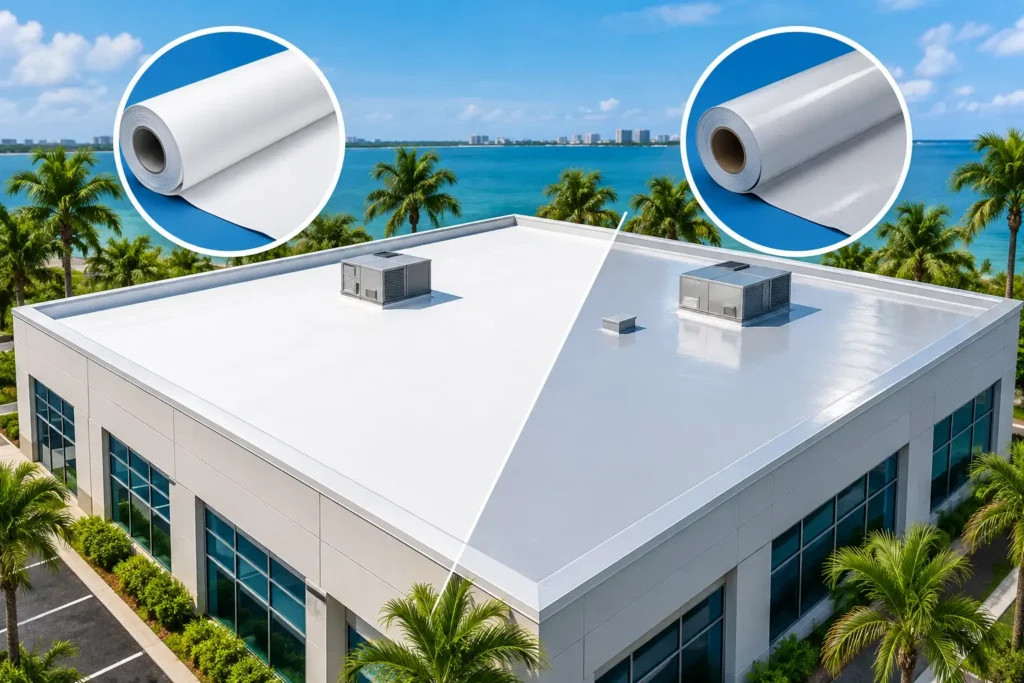
Both are single-ply membranes used on commercial buildings, multifamily properties, covered patios, additions, and other low-slope applications. Both can deliver a clean white reflective surface that helps reduce heat gain. Both use heat-welded seams rather than relying only on adhesives. But the material chemistry, long-term performance profile, and ideal use cases are different.
TPO Versus PVC Roofing: The Core Difference
TPO stands for thermoplastic polyolefin. It is typically made from polypropylene and ethylene-propylene rubber, reinforced with a polyester scrim. It has become one of the most common commercial roofing choices because it offers strong reflective performance at a competitive price.
PVC stands for polyvinyl chloride. It is also a reinforced thermoplastic membrane, but its chemical composition gives it a distinct advantage around oils, grease, many chemicals, and certain industrial contaminants. PVC has a longer track record in the commercial roofing market and is often selected where the roof must withstand more demanding exposure.
In practical terms, TPO is usually the value-focused choice for a standard commercial or residential low-slope roof. PVC is often the higher-cost, higher-specialization choice for restaurants, manufacturing facilities, commercial kitchens, and buildings where grease vents or chemical exhaust are part of daily operations.
Where TPO Performs Well in Florida
A properly specified and installed TPO roof can be an excellent fit for offices, retail spaces, churches, warehouses, multifamily buildings, and residential flat-roof sections. White TPO reflects a meaningful amount of solar heat, which can help reduce rooftop temperatures and ease the burden on air-conditioning systems during Florida’s long cooling season.
TPO also offers good flexibility and weldable seams. Those seams matter because many low-slope roof leaks start where sheets meet, at penetrations, or where the membrane turns up a wall. When heat welding is done correctly, the seam becomes a strong, continuous bond that is designed to resist water intrusion.
Cost is another reason owners choose TPO. Material and installation costs are often lower than PVC, though pricing depends on membrane thickness, insulation, attachment method, roof access, tear-off needs, parapet walls, penetrations, and code requirements. A roof with complex drains, curbs, skylights, and HVAC equipment will not price like a wide-open warehouse roof.
TPO is not automatically the best value simply because its initial number may be lower. The membrane must be from a proven manufacturer, installed at an appropriate thickness, and detailed correctly at every edge and penetration. On the East Coast of Florida, wind uplift design and perimeter securement are not optional details. They are central to the roof system.
TPO limitations to consider
TPO is less suited to roofs exposed to persistent grease or chemical discharge. Exhaust from a restaurant kitchen can degrade materials over time, and a membrane that works well on a medical office may not be the prudent choice over a busy commercial kitchen.
The quality of TPO products has also varied across manufacturers and product generations. That does not mean TPO is unreliable. It means owners should avoid making a decision based on membrane color and price alone. Manufacturer approval, system compatibility, warranty terms, membrane thickness, and contractor workmanship deserve a close review.
When PVC Roofing Earns Its Higher Price
PVC is especially known for chemical and grease resistance. For a restaurant, food-processing site, laboratory, or facility with rooftop exhaust containing oils or chemical vapors, that resistance can protect the roof from early deterioration. In these settings, choosing a less expensive membrane that is not built for the exposure can turn into a costly mistake.
PVC is also highly reflective, heat-weldable, and well suited for low-slope applications. Like TPO, it can be installed in mechanically attached, fully adhered, or other manufacturer-approved assemblies. The best attachment method depends on the deck, insulation package, wind zone, building height, and the roof’s overall design.
A PVC roof often has a higher upfront cost, but the premium can make sense when it addresses a known operational risk. If the building has grease-producing exhaust, the comparison is not TPO versus PVC based on price alone. It is PVC’s added cost versus the cost and disruption of a roof that may not tolerate the environment.
PVC can also be a wise option for owners who want a membrane with an extensive history in demanding commercial environments. Still, no membrane solves poor drainage, neglected rooftop equipment, or weak flashing details. Even premium materials need disciplined installation and regular inspection.
Heat, Storms, and Salt Air Change the Decision
Florida roof selection must account for more than sunlight. A reflective white membrane is beneficial, but coastal weather brings another set of demands: hurricane-force winds, sudden downpours, humid conditions, and salt-laden air. TPO and PVC can both be engineered for high-wind applications, but only as complete, tested roof assemblies.
That assembly includes the membrane, insulation, fasteners or adhesive, cover board where needed, edge metal, flashing, drains, and termination details. A strong membrane installed with the wrong fastening pattern or poorly secured perimeter metal is not a storm-ready roof.
Drainage deserves equal attention. Neither TPO nor PVC is meant to excuse chronic ponding water. Many roofs can tolerate limited temporary water after a major rain event, but water that remains for days may reveal poor slope, clogged drains, or a design issue that needs correction. Before replacing a roof, inspect the deck, drains, scuppers, gutters, and areas where water routinely collects.
For buildings close to the coast, compatible metal details and careful maintenance are also essential. Salt air does not only affect the membrane. It can accelerate corrosion at fasteners, edge components, rooftop supports, and mechanical equipment. The roof needs to be planned as a complete protective system.
How to Choose Between TPO and PVC
Start with how the building uses its roof. A standard office, retail building, or residential low-slope section with no grease or chemical exposure may be well served by a quality TPO system. A restaurant or facility with grease-laden exhaust is usually a stronger candidate for PVC.
Then look beyond the membrane. Ask whether the proposal addresses insulation value, moisture within the existing assembly, drainage corrections, edge metal, penetrations, wind-uplift requirements, and manufacturer warranty eligibility. A proposal that only lists a membrane thickness without explaining the full system leaves too much unanswered.
Budget matters, but it should be evaluated over the expected service life of the roof. The least expensive proposal can become the most expensive if it omits needed deck repairs, uses weak details around equipment, or does not account for the building’s actual exposure. No surprises. No disappearing act. A contractor should explain what is included, what may change after tear-off, and how those findings will be documented.
For property managers, scheduling is part of the equation as well. A roof replacement may need to be phased to protect operations, tenants, inventory, and customer access. The right system is one that performs after installation and can be installed with a clear plan for safety, weather monitoring, debris control, and communication.
Installation Quality Is the Deciding Factor
The best membrane cannot cover for poor workmanship. Heat-welded seams must be tested, flashings must be properly formed, drains must be detailed to move water, and transitions to walls or other roof types must be watertight. Roofing crews also need to protect the membrane from unnecessary traffic and coordinate carefully around HVAC contractors and other trades.
At Bear Roofing, the recommendation begins with the building rather than a one-size-fits-all product. A thorough inspection can identify wet insulation, deteriorated decking, drainage concerns, storm damage, and the details that affect insurance or code compliance. That is how owners receive a system recommendation they can understand and a scope they can hold a contractor accountable for.
A roof is easier to choose when the questions are specific: What is venting onto it? Where does water go after a heavy rain? What wind requirements apply to this property? How will the seams, edges, drains, and equipment curbs be handled? Clear answers now protect the building long after the crew has cleaned up the site.