
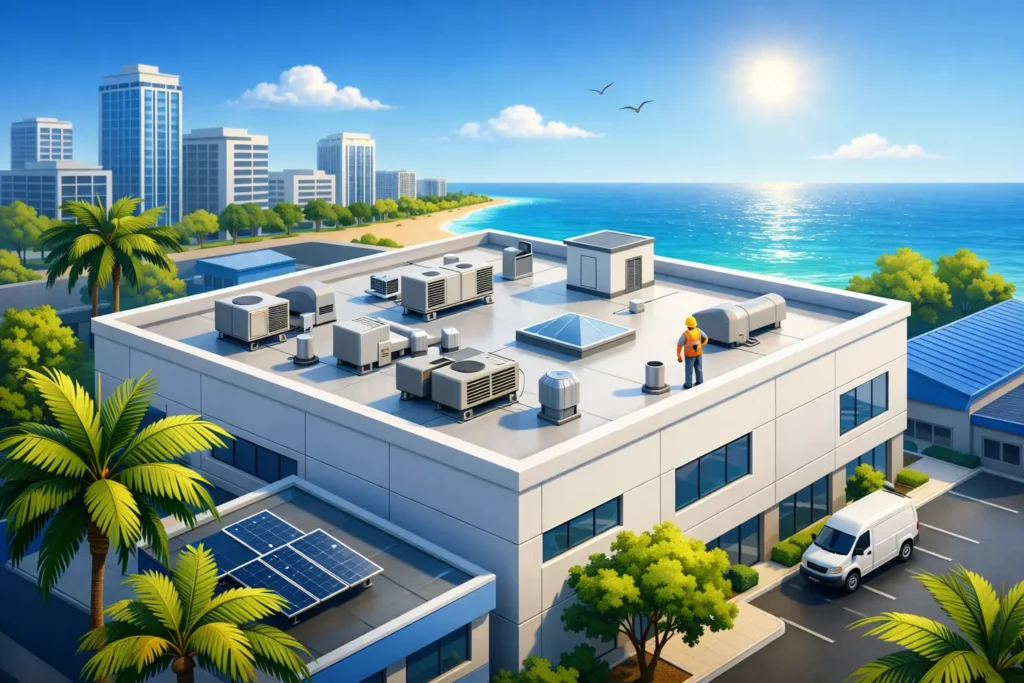
A commercial roof can look fine from the parking lot while holding water at a drain, separating at a seam, or allowing moisture into the insulation below. That is why a commercial flat roofing guide should start with the realities Florida property owners face: intense UV exposure, wind-driven rain, humidity, salt air near the coast, and storm seasons that can turn a minor weakness into an interior leak.
For business owners and property managers, the right roof is not simply the lowest bid or the membrane with the longest brochure warranty. It is a complete system designed for your building, drainage pattern, occupancy, budget, and long-term maintenance plan. Get those pieces right, and your roof protects operations instead of interrupting them.
What “Flat” Roofing Really Means
Most commercial flat roofs are low-slope roofs, not perfectly level surfaces. They need enough slope to move water to drains, scuppers, or gutters. When water remains on a roof longer than it should, it increases stress on seams, flashings, and penetrations. In Florida, standing water also creates a dirty surface that can conceal developing problems.
A dependable commercial roof is made up of more than the visible top layer. The assembly may include a structural deck, vapor barrier, insulation, cover board, membrane, flashings, edge metal, drainage components, and sealants around vents, curbs, and mechanical equipment. A failure in any one of these areas can compromise the roof.
That is why an inspection should look beyond a single crack or stain. The real question is whether the whole assembly is still doing its job.
Choosing a Commercial Flat Roofing System
There is no one material that fits every Florida commercial building. The best choice depends on roof traffic, drainage, exposure, building use, code requirements, and whether you are repairing, restoring, or replacing the roof.
TPO Roofing
TPO is a single-ply membrane commonly used on commercial buildings because it provides a clean, reflective surface and can help manage heat gain. Seams are heat-welded, which creates a strong connection when installed correctly. It is often a practical choice for offices, retail centers, warehouses, and other low-slope applications.
TPO performance depends heavily on the details. Membrane thickness, fastening pattern, perimeter securement, flashing work, and installer skill all matter. A lower price may reflect thinner material, fewer necessary components, or shortcuts around roof edges and penetrations. Those are not places to compromise in a high-wind region.
PVC Roofing
PVC is another heat-welded single-ply system. It is known for strong resistance to chemicals, grease, and moisture, making it worth considering for restaurants, facilities with exhaust systems, and certain industrial uses. It usually carries a higher upfront cost than some alternatives, but the application may justify it when the roof faces grease or chemical exposure.
Modified Bitumen Roofing
Modified bitumen is an asphalt-based system installed in multiple layers. It can be a strong fit for roofs with frequent foot traffic or complicated layouts because the layered construction provides durability and repairability. The system can be installed with different application methods, depending on building conditions and project requirements.
Its trade-off is weight and installation complexity. The roof deck and structure must be evaluated, and the finished system needs properly designed drainage to avoid premature wear.
Metal and Fluid-Applied Coatings
A roof coating can extend the service life of an existing low-slope roof when the substrate is dry, stable, and still structurally sound. Coatings can improve reflectivity and seal minor surface imperfections, but they are not a shortcut for saturated insulation, failed seams, widespread ponding water, or storm damage.
Coatings work best as part of a restoration plan, not as a temporary paint-over. Before recommending one, a contractor should inspect adhesion, moisture conditions, existing repairs, drainage, and the roof’s remaining life.
Drainage Is a Roofing Decision, Not a Maintenance Detail
Florida rainstorms can drop a large amount of water in a short time. If drains are undersized, clogged, poorly placed, or surrounded by low spots, water can remain on the roof long after the storm has passed. That water adds weight, invites membrane deterioration, and increases the chance of leaks at vulnerable details.
During a commercial roof assessment, look at where water travels and where it stops. Common warning signs include stain rings around drains, algae growth, gravel or debris collecting in one area, soft insulation, and repeated leaks after heavy rain.
Correcting drainage may involve cleaning and repairing drains, adding tapered insulation to create positive slope, adjusting scuppers, or addressing structural low areas. The right remedy depends on the building. A coating alone will not solve a roof that consistently holds water.
The Details That Usually Determine Roof Life
Large, open membrane areas matter, but many commercial roof failures begin at transitions. Flashings around HVAC curbs, pipes, skylights, parapet walls, roof hatches, and expansion joints deserve close attention. These areas move differently from the rest of the roof as temperatures rise and fall, and they are exposed to water from multiple directions.
Roof edges are equally critical on Florida’s East Coast. Wind does not need to lift an entire roof at once. It can start by working under loose edge metal or weak perimeter fastening, then progressively pull on the system during a severe storm. Proper fastening and code-conscious installation are part of protecting the building envelope.
Mechanical work can also create problems. HVAC service crews may damage a membrane, leave sharp objects behind, or disturb flashing around equipment. Walk pads and clear service pathways help protect areas that receive regular traffic.
Repair, Restore, or Replace?
The decision should be based on evidence, not guesswork. A localized puncture or a separated seam may be repaired successfully if the surrounding membrane and insulation remain dry. A roof with broad surface deterioration, recurring leaks, failing flashings, or saturated insulation may need more than patchwork.
A professional evaluation should identify the source of moisture, not just the place where water appeared inside. Water can travel through insulation or along a deck before showing up on a ceiling tile several feet away.
Consider a full replacement when repairs are becoming frequent, storm damage has affected a large area, the roof has reached the end of its expected service life, or moisture has compromised underlying materials. While replacement requires a larger investment, it can prevent repeated disruptions, interior damage, and emergency repair costs.
A Practical Commercial Roof Maintenance Plan
Commercial roofs need scheduled attention, particularly before and after hurricane season. Waiting for a ceiling leak usually means the issue has progressed beyond the exterior surface.
A practical maintenance plan should include these regular checks:
- Inspect the roof at least twice each year and after major wind or rain events.
- Clear drains, scuppers, gutters, and roof valleys of leaves, sediment, and loose materials.
- Check seams, flashings, edge metal, sealant joints, and areas around rooftop equipment.
- Document repairs, leaks, inspections, and photographs so patterns are easier to identify.
- Limit unnecessary roof traffic and use walk pads where service personnel travel repeatedly.
This recordkeeping is useful for budgeting, warranty compliance, and insurance documentation after a storm. It also gives property managers a clearer picture of whether the roof is stable or becoming a recurring expense.
What to Expect From a Commercial Roofing Contractor
A commercial roofing proposal should be clear enough to evaluate. You should know the system being installed, membrane thickness or assembly type, insulation approach, drainage work, flashing details, removal or recovery plan, permit responsibilities, projected schedule, warranty terms, and cleanup expectations.
Ask how the contractor will protect tenants, customers, inventory, landscaping, and rooftop equipment during the work. For occupied buildings, project planning matters as much as the material selection. A restaurant, medical office, retail store, or multi-tenant property may need phased work and clear communication to reduce disruption.
At Bear Roofing, the goal is to give Florida property owners a straightforward assessment and manage the work from inspection through cleanup. No surprises. No disappearing act. A roof should come with a clear plan, accountable workmanship, and protection that makes sense for the building.
The best time to evaluate a commercial roof is while it is still protecting your property. Schedule an inspection before the next major storm exposes a weakness, and use what you learn to plan repairs or replacement on your terms.