
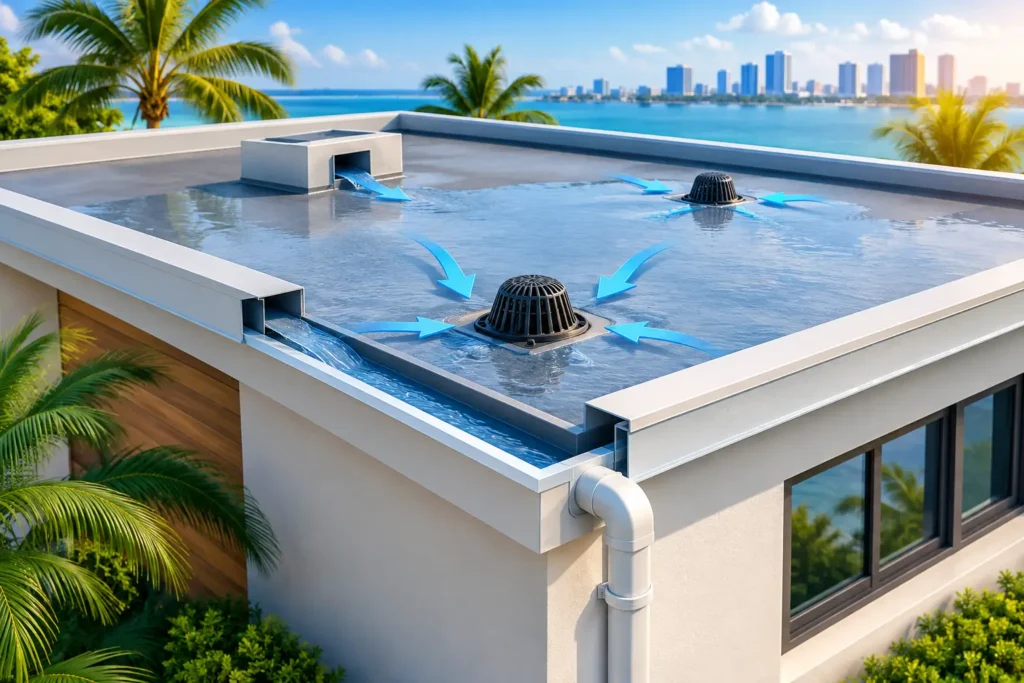
A flat roof can look fine from the ground while holding inches of water above your ceiling. In Florida, that standing water is not a minor maintenance issue. Heavy downpours, wind-driven rain, humidity, and year-round sun can turn a slow-draining roof into a leak, membrane failure, or costly interior repair. The best drainage solutions flat roofs need are designed around the roof’s slope, size, drain capacity, and the way water actually moves during a storm.
For homeowners, business owners, and property managers on Florida’s East Coast, the right answer is rarely a single drain or a quick patch. It is a complete drainage plan that moves water off the roof reliably, protects the roofing system, and provides a clear path for maintenance.
Why Flat Roof Drainage Fails in Florida
Despite the name, a properly built flat roof is not truly flat. It needs positive slope that directs water toward drains, scuppers, gutters, or roof edges. When that slope is too shallow, interrupted by rooftop equipment, or altered by settling, water remains behind after a storm. This is called ponding.
Ponding water puts extra weight on the roof deck and keeps the membrane wet longer. Over time, it can accelerate seam wear, stress flashing, collect debris, and expose small defects that might otherwise stay dormant. On a commercial roof, it can also create safety concerns and disrupt operations below.
Drainage problems are often caused by more than one issue: undersized drains, clogged strainers, poor roof geometry, sagging areas, insufficient overflow protection, or a drainage layout that was never designed for Florida rainfall intensity. The repair that lasts addresses the cause, not just the puddle.
Best Drainage Solutions for Flat Roofs
The right system depends on whether the roof drains internally, sheds water at its perimeter, or needs a combination of both. A qualified roofing contractor should inspect the roof after rain when possible, identify the low spots, and calculate whether the current drainage capacity matches the building and roof area.
Tapered Insulation Creates the Needed Slope
Tapered polyiso insulation is one of the most effective solutions for a roof with widespread ponding. Instead of removing and rebuilding the entire structural deck, the roofing team installs insulation boards that gradually change in thickness. This creates a controlled slope toward designated drains or scuppers.
This approach is especially valuable during a flat roof replacement because it improves drainage and can improve thermal performance at the same time. It is not always the lowest-cost option upfront, but it can prevent repeated patching and extend the life of the new roofing system.
Tapered insulation must be planned carefully. Adding slope changes roof elevations, flashing heights, door thresholds, equipment curbs, and edge details. A contractor should account for every one of those conditions before installation. No surprises. No improvised fixes after the roof is installed.
Internal Drains Work Well on Larger Roof Areas
Internal roof drains collect water through drain bowls installed within the roof field. Water then moves through piping inside the building and out to an approved discharge point. They are common on commercial buildings and on larger low-slope roofs where sending all runoff to the perimeter is impractical.
When properly sized and maintained, internal drains provide efficient, direct drainage. Their main trade-off is maintenance. Leaves, sediment, roofing debris, and loose ballast can block the drain strainer. If an internal drain is clogged during a hard storm, water has nowhere to go except across the roof surface.
For that reason, internal-drain systems should include properly located overflow drains or scuppers. These backups are not optional details. They reduce the risk of excessive water buildup if the primary drain cannot keep up or becomes blocked.
Scuppers Provide Dependable Perimeter Drainage
Scuppers are openings through a parapet wall that allow water to exit the roof. They can discharge into downspouts, leader heads, or open areas designed to carry water away from the building. For many Florida low-slope roofs, scuppers are a practical, visible drainage solution.
Their visibility is a benefit. A property owner can often see when water is flowing correctly, and a blockage is easier to identify than one hidden inside a drain line. Scuppers also serve as effective emergency overflow outlets when placed above the primary drainage level.
The details matter. A scupper must be sized for the roof area and expected rainfall, properly flashed into the roofing membrane, and positioned so runoff does not wash down walls, flood walkways, or damage landscaping. On coastal properties, corrosion-resistant components are also worth considering because salt air is hard on exposed metal.
Gutters and Downspouts Suit Some Residential Flat Roofs
A residential flat or low-slope roof may drain successfully to an edge gutter system, particularly on smaller additions, porches, garages, and modern home designs. Gutters collect runoff along the eave, while downspouts direct water safely away from the foundation and entry areas.
This setup is straightforward, but it requires regular cleaning. Palm fronds, oak leaves, roof granules, and storm debris can clog gutters quickly. A gutter that overflows can send water behind fascia boards, into soffits, or down exterior walls.
Gutters are best when the roof has enough slope toward the edge and the perimeter is designed to handle the water volume. They are not a cure for low spots in the middle of the roof. If ponding occurs away from the edge, the slope still needs correction.
Crickets and Saddles Move Water Around Obstacles
Mechanical units, skylights, curbs, chimneys, and parapet walls can interrupt the natural path of water. Crickets and saddles are raised, sloped sections that divide or redirect runoff around those obstacles and toward a drain or scupper.
They are small details with a major effect on roof performance. Without them, water can pool against curbs and penetrations, where flashing is already under more stress. During a replacement or restoration project, these drainage details should be included in the design rather than treated as an afterthought.
Drainage Is Part of the Roofing System
A drain cannot protect a failing membrane, and a new membrane cannot perform as intended if water has no reliable exit. The roof covering, insulation, flashings, drains, overflow system, and edge metal need to work together.
For example, a silicone or acrylic roof coating may help protect an existing low-slope roof from UV exposure and minor weathering, but coating over a ponding problem without correcting drainage can lead to disappointment. Some coating systems tolerate standing water better than others, but persistent ponding still increases maintenance needs and can expose weak areas over time.
The same principle applies to roof repairs. If a leak appears near a drain, the source may be damaged flashing, a blocked line, deteriorated membrane seams, or water backing up from a poor slope. A professional inspection should determine which condition is present before repairs begin.
What Florida Property Owners Should Check
After a heavy rain, look for water that remains on the roof beyond 48 hours, overflow marks on parapet walls, stained ceiling tiles, bubbling coatings, loose membrane seams, or downspouts that are not discharging. These are signs that deserve prompt attention, especially before hurricane season.
Property managers should also schedule routine drain and gutter cleaning. The exact frequency depends on tree cover, roof traffic, and nearby construction, but quarterly checks are a sensible starting point for many Florida properties. A roof should also be inspected after a named storm or any event that leaves debris on the surface.
Do not assume a drain is clear because water is moving during light rain. Florida storms can deliver intense rainfall in a short period. The system needs enough capacity for real conditions, plus a safe overflow path if the primary outlet fails.
Choose a Contractor Who Designs for Water, Not Just Materials
The best drainage solution begins with an honest assessment of the existing roof. That means checking slope, measuring ponding areas, inspecting drain bowls and scuppers, evaluating the deck, and reviewing how runoff leaves the property. It also means explaining whether a repair is appropriate or whether the roof needs redesigned drainage as part of replacement.
Bear Roofing approaches flat roof work with Florida weather, building requirements, and long-term protection in mind. A clear scope of work should identify how water will move across the finished roof, where it will exit, and how the details will be protected under warranty.
Water always finds the weakest point. Give it a clear route off the roof, maintain that route, and your flat roof has a far better chance of protecting the property through the next hard Florida storm.